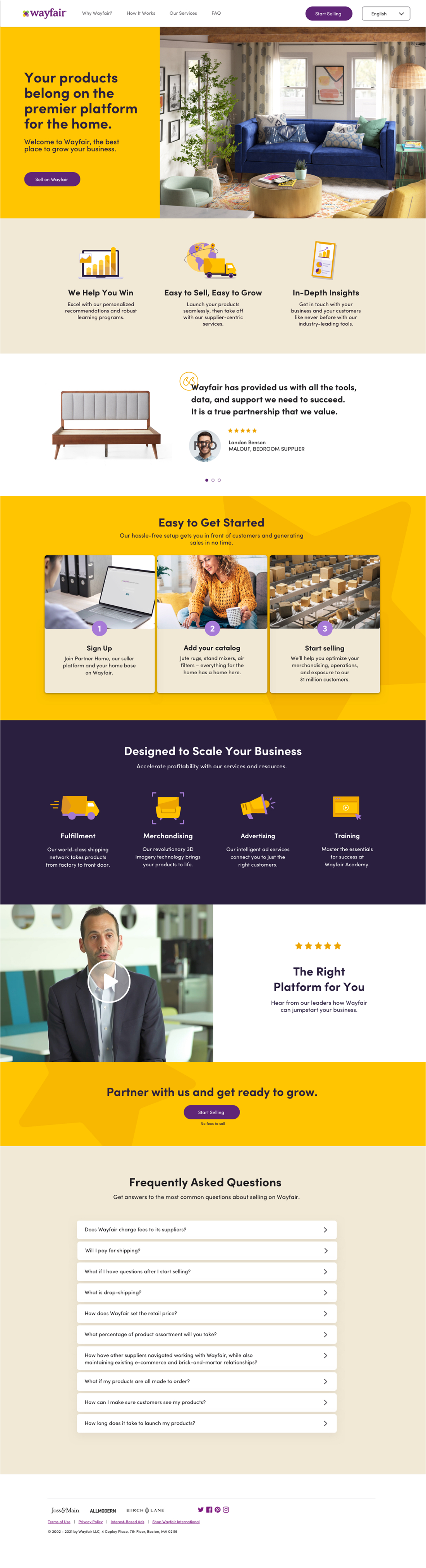
One page, one job: turn a skeptical supplier into a signup.
The audience isn't a shopper browsing sofas — it's a business owner deciding whether to trust a platform with their catalog, their margins, and their brand. With Supplier Marketing, I gathered the questions those suppliers were actually asking — from sales calls, account managers, and onboarding — and sorted them until the pattern was unmistakable. Every question came down to one of three worries: money, control, or success. Those three worries became the message pillars, and every answer was assigned a home on the page.
I wrote the page as an argument before it was a layout.
The structure carried the argument — promise, value, proof, process, reassurance, in that order. I wrote the content and delivered it as a low-fi wireframe — copy final, rationale annotated in the margin — then handed it to a product designer to bring the visual system.
Shipped globally, built to localize.
The page shipped as Wayfair's global supplier-recruitment front door, with the copy structured to localize across Wayfair's North American and European markets — consistent terminology, language-selector-ready, no idioms that wouldn't travel. And the value statements outlived the page: partner-facing teams reused them, so suppliers heard the same pitch everywhere — on this page, in a sales deck, or during onboarding.